

It’s Day 12 of a new client engagement. The engagement letter was signed two weeks ago. Documents trickled in — some bank statements here, a partial employee list there. Now payroll is due in three days, and you’re missing TD1 forms for half the staff, the chart of accounts from their old Xero file doesn’t map to anything in your system, and the client just mentioned a merchant account with Stripe that nobody told you about.
Sound familiar?
Most accounting firms assume onboarding wraps up once the engagement letter is signed and files start landing in the inbox. It doesn’t. That’s actually where the real work begins. Every payroll run, every reconciliation, every GST/HST filing, every financial report you’ll produce for this client over the next twelve months — the quality of all of it gets determined in these first few weeks.
A rushed onboarding process doesn’t just create headaches now. It manufactures weeks of corrective work later.
This guide walks you through a repeatable onboarding process that prepares every new client for a clean first month-end close — so you’re not still fixing onboarding gaps in month three.
What Should Be Included in an Accounting Firm Client Onboarding Checklist?
A complete client onboarding checklist for accounting firms should cover: engagement letter and scope of services, business identification (including BN and CRA program accounts), banking information for all accounts and payment processors, bookkeeping records such as the chart of accounts and historical financial data, payroll details including employee lists and TD1 forms, tax registrations and filing frequencies for GST/HST, technology access and user permissions for accounting and payroll software, and a defined communication workflow covering approval contacts, document request processes, and response timelines.
Why Client Onboarding Matters More Than Most Firms Realize
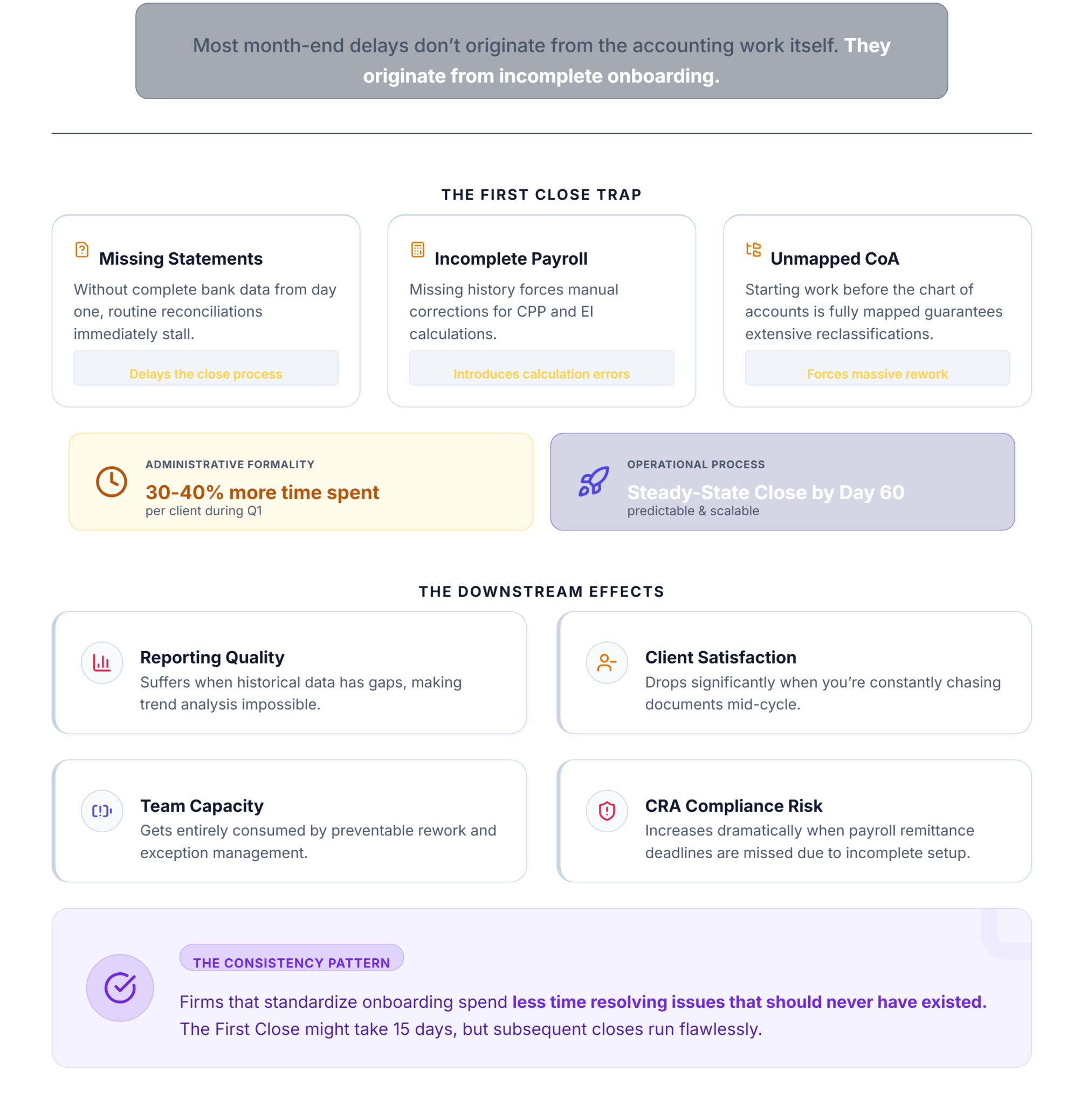
Most month-end delays don’t originate from the accounting work itself. They originate from incomplete onboarding.
When a firm starts bookkeeping or payroll processing without complete documentation, the consequences compound. Missing bank statements mean reconciliations stall. Incomplete payroll history means CPP and EI calculations need manual correction. An unmapped chart of accounts means the first close — what practitioners call the First Close (Extended) — stretches from the typical 5 days to 15 or more.
Here’s what I’ve seen repeatedly across firms: the ones that treat onboarding as an administrative formality end up spending 30-40% more time on each client during the first quarter. The ones that treat it as an operational process hit Steady-State Close by Day 60.
The downstream effects touch everything:
- Reporting quality suffers when historical data has gaps
- Client satisfaction drops when you’re chasing documents mid-cycle
- Team capacity gets consumed by preventable rework
- CRA compliance risk increases when payroll remittance deadlines are missed due to incomplete setup
The pattern is consistent: firms that standardize onboarding spend less time resolving issues that should never have existed.
Before You Request Any Documents
Before sending a single document request, lock down the engagement framework. This is your Pre-Flight Check.
The Engagement Letter (Scope) must clearly define what’s included and — just as critically — what’s excluded. If you’re handling bookkeeping but not tax filing, say so explicitly. If payroll is in scope but benefits administration isn’t, spell it out. Ambiguity in the engagement letter creates scope disputes that erode the relationship months later.
Cover these items before anything else:
- Scope of services: Bookkeeping, payroll, GST/HST filing, financial reporting — what’s in, what’s out
- Responsibilities: What the firm handles vs. what the client must provide (and by when)
- Communication expectations: Who’s the primary contact? How are documents submitted? What’s the expected response time?
- Timelines: When does active work begin? What’s the target date for the first month-end close?
- Primary contacts: Name the person on the client side who approves payroll, signs off on reports, and responds to document requests
Stop/Go Test: Can you describe, in one sentence, exactly what services you’re providing and what the client is responsible for? If not, the engagement letter needs more work before you proceed.
The Complete Client Onboarding Checklist
Here is a practical checklist that accounting firms can use before beginning bookkeeping or payroll work. Each section covers a distinct operational area, and skipping any of them creates risk downstream.
1. Business Information
- ☐ Legal business name (as registered with CRA)
- ☐ Business Number (BN) — the 9-digit CRA identifier
- ☐ All CRA program accounts (GST/HST, payroll, corporate tax)
- ☐ Fiscal year-end date
- ☐ Province of registration
- ☐ Industry and NAICS code
- ☐ Corporate structure (sole proprietor, partnership, corporation)
Operational note: Run KYB verification early. I’ve seen onboarding stall for weeks because the operating agreement was missing or the BN didn’t match CRA records. Get the “BN Verified” confirmation before moving to the next phase.
2. Banking Information
- ☐ All business bank accounts (chequing, savings)
- ☐ Business credit cards
- ☐ Loan and line of credit accounts
- ☐ Merchant accounts (Square, Stripe, Shopify Payments)
- ☐ Payment processor details
Friction warning: Clients regularly forget to mention secondary accounts or payment processors. A Stripe account processing $15,000/month that nobody told you about will blow up your first reconciliation. Ask specifically: “Are there any accounts where money comes in or goes out that we haven’t discussed?”
3. Bookkeeping Documents
- ☐ Current chart of accounts
- ☐ Most recent trial balance
- ☐ General ledger export (last 12 months minimum)
- ☐ Historical bank and credit card statements
- ☐ Previous financial statements
- ☐ Opening balances for the transition period
COA Mapping is where many firms lose days. If the client’s legacy software used “uncategorized” or suspense accounts, don’t try to clean everything in the first close. Create a temporary “Legacy Suspense” account, map unmapped entries there, and clean them in the second close. Trying to fix historical categorization issues while also closing the books is how you end up doing Prior-Period Reconstruction work you didn’t budget for.
For firms managing transaction categorization across multiple clients, standardized COA templates save enormous time.
4. Payroll Information
- ☐ Complete employee list with SINs and addresses
- ☐ Federal and provincial TD1 forms for every employee
- ☐ Pay schedules and pay dates
- ☐ Compensation details (salary, hourly rates, commissions)
- ☐ Benefits and deduction details
- ☐ Current vacation balances and accrual policies
- ☐ CPP/EI exemptions or special circumstances
- ☐ Year-to-date payroll history (critical for mid-year transitions)
- ☐ T4 history from the previous year
- ☐ Outstanding ROE information
This is the section that causes the most problems. Missing payroll history leads to incorrect CPP and EI calculations. Wrong TD1 information means incorrect tax withholdings. And if you’re onboarding mid-year without YTD totals, you’re essentially guessing — which leads to the kind of payroll mistakes that trigger CRA penalties.
Also confirm worker classification upfront. If the client has people they’re calling “contractors” who are actually employees, that’s a compliance issue you need to flag before processing a single payment.
5. Tax Information
- ☐ GST/HST registration number and filing frequency
- ☐ Most recent GST/HST returns (last 4 quarters)
- ☐ Any outstanding CRA correspondence or assessments
- ☐ Payroll account numbers
- ☐ Corporate tax filing history (T2)
- ☐ Provincial tax obligations
Get the GST/HST Consent signed early. I’ve seen digital signatures rejected because the platform didn’t capture the specific CRA jurisdiction field. If there’s any doubt, use a wet-ink signature for the initial consent.
6. Technology Access
- ☐ Current accounting software credentials and admin access
- ☐ Payroll software access
- ☐ Bank feed connections (verify these are active — check for the “Feed Active” pulse, not just a connected status)
- ☐ Cloud storage access for shared documents
- ☐ User permissions for all team members who’ll touch the file
The “Bank Feed Lag” Test: After connecting feeds, check the most recent transaction date. If it’s more than 2 days behind today’s date, re-authenticate immediately. Bank tokens expire during migration more often than you’d expect — Payroll Feed Verification failures almost always trace back to this.
7. Client Communication Process
- ☐ Who approves payroll runs?
- ☐ Who reviews and signs off on monthly bookkeeping?
- ☐ How are reports delivered? (Portal, email, scheduled call)
- ☐ How does the client submit documents and receipts?
- ☐ What are agreed response timelines for document requests?
Clear communication expectations set during onboarding reduce client friction throughout the entire engagement. When firms skip this step, they end up chasing approvals through endless email chains that don’t scale.
Common Client Onboarding Mistakes
| Mistake | Why It Happens | Downstream Impact |
|---|---|---|
| Starting work before complete documentation arrives | Pressure to show progress | Reconciliation gaps, rework |
| Inconsistent checklists across clients | No standardized process | Missed items, variable quality |
| Not verifying opening balances | Assumed prior firm’s numbers were correct | Balance sheet errors that persist for months |
| Missing payroll YTD history | Client didn’t know it was needed | Incorrect CPP/EI, amended T4s |
| Ignoring historical adjustments | “We’ll fix it later” mentality | Prior-Period Reconstruction in month 3 |
| Unclear responsibilities | Engagement letter was too vague | Scope disputes, client frustration |
| No defined communication workflow | Assumed it would work itself out | Delayed approvals, missed deadlines |
The “5-Contact” Random Check is worth doing early: pick 5 random records from any uploaded client data. If 3 have missing fields or formatting errors, stop and request a clean export before proceeding. Bad data in means bad data out.
How Successful Accounting Firms Standardize Onboarding
Firms that manage payroll across multiple clients can’t afford to reinvent onboarding each time. The ones that scale well build a system:
- Standardized templates for every document request
- Workflow checklists that track completion by category (not just a single “onboarding complete” checkbox)
- Task assignments with clear ownership — who’s responsible for collecting payroll data vs. setting up bank feeds
- Centralized documentation in a client portal, not scattered across email threads and shared drives
- A recurring onboarding review process where outstanding items are flagged weekly until the first close is complete
The firms still running onboarding through email and spreadsheets consistently report higher costs per client and longer time-to-close. Platforms that support secure multi-client workspaces, employee onboarding with TD1 capture, COA setup, and historical transaction imports reduce the manual coordination that makes bookkeeping unnecessarily expensive.
Ready to standardize your firm’s onboarding workflow?
LedgerNext provides secure client workspaces, payroll onboarding, document sharing, and CRA-ready reporting — built specifically for Canadian accounting firms managing multiple clients.
Preparing for the First Month-End Close
The First Close (Extended) will always take longer than a normal month-end. That’s expected. But “longer” should mean 10-15 days, not 30.
Before attempting the first close, verify every item on this readiness checklist:
First Month-End Readiness Checklist:
- ✅ Payroll is fully set up — employee data, TD1s, YTD history, pay schedules confirmed
- ✅ All bank accounts and credit cards are connected with active feeds
- ✅ Chart of accounts is mapped (including a Legacy Suspense account if needed)
- ✅ Opening balances reconcile to the prior firm’s closing balances (variance must be < $1)
- ✅ GST/HST registration is confirmed and filing frequency is set
- ✅ All outstanding documents from the onboarding checklist are received
- ✅ The Three-Tier Quality Review process is defined (Preparer → Manager → Partner)
- ✅ Client communication contacts and approval workflows are confirmed
Run the “COA Balance” Reconciliation before closing: compare total balances from the client’s historical GL export against totals in your system. If they differ by more than a dollar, stop and investigate before finalizing anything.
Best Practices for Creating a Repeatable Onboarding Process
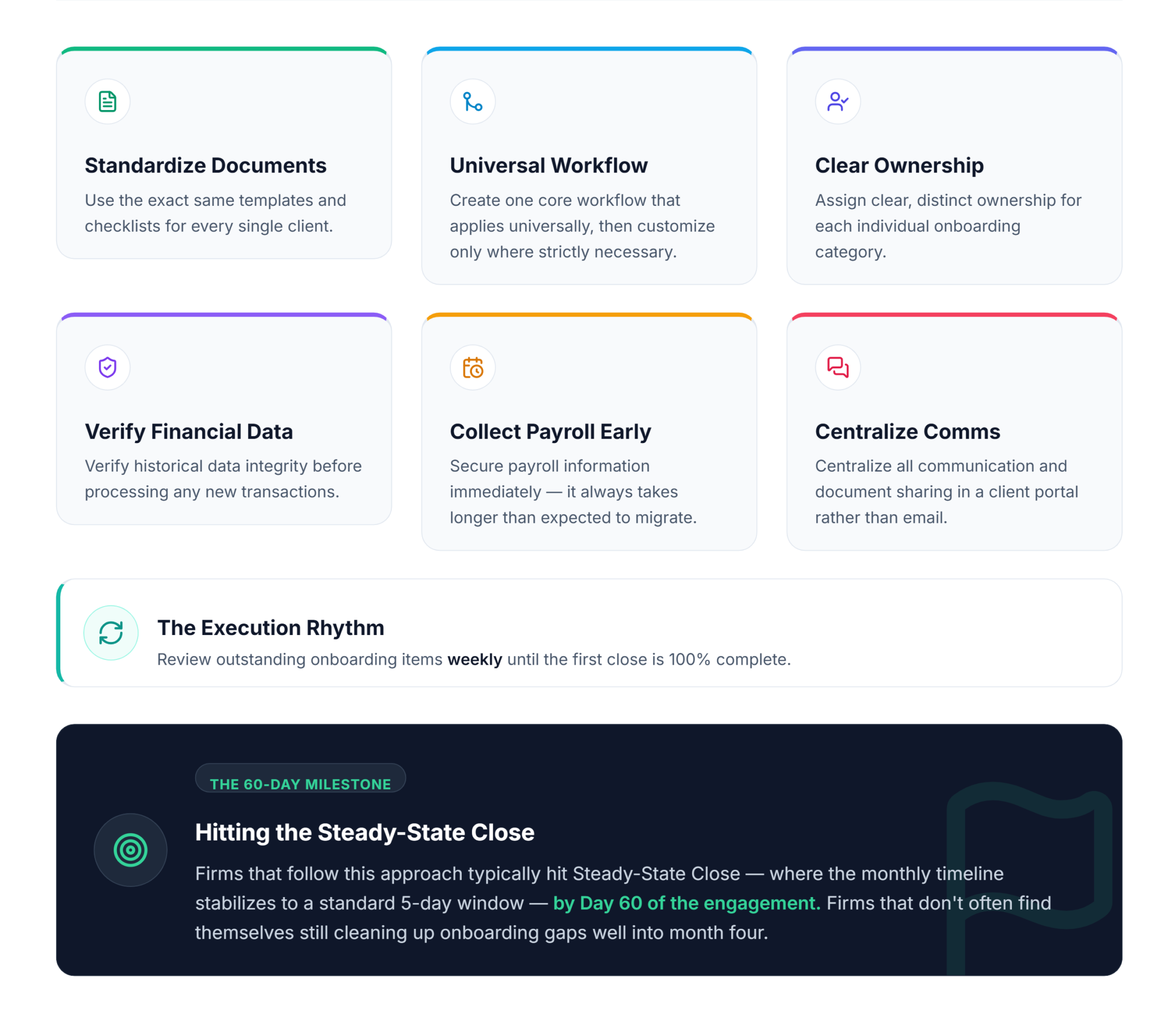
- ✓ Standardize onboarding documents — use the same templates for every client
- ✓ Create one workflow that applies universally, then customize only where necessary
- ✓ Assign clear ownership for each onboarding category
- ✓ Verify financial data before processing any transactions
- ✓ Collect payroll information early — it always takes longer than expected
- ✓ Centralize communication in a client portal rather than email
- ✓ Review outstanding onboarding items weekly until the first close is complete
Firms that follow this approach typically hit Steady-State Close — where the monthly timeline stabilizes to a standard 5-day window — by Day 60 of the engagement. Firms that don’t often find themselves still cleaning up onboarding gaps well into month four.
FAQ
What documents should accounting firms request from new clients?
Firms should collect business identification (BN, CRA accounts), bank statements, credit card statements, chart of accounts, general ledger exports, payroll records including TD1 forms and YTD history, GST/HST registration details, prior financial statements, and technology access credentials. A standardized checklist prevents missed items.
How long should client onboarding take?
Most accounting firms should allow 2-4 weeks for complete onboarding before attempting the first month-end close. The First Close (Extended) typically requires 10-15 business days. Firms generally reach Steady-State Close by Day 60 of the engagement.
What payroll information should be collected during onboarding?
Collect employee lists with SINs, federal and provincial TD1 forms, pay schedules, compensation details, benefits and deductions, vacation balances, CPP/EI exemptions, year-to-date payroll history, T4 history, and any outstanding ROE information. Missing YTD data is the most common source of payroll errors.
Why is onboarding important for bookkeeping?
Onboarding determines whether reconciliations, categorization, and reporting run smoothly from month one. Incomplete bank account information, unmapped charts of accounts, and missing historical data create errors that compound across every subsequent reporting period.
How can accounting firms standardize onboarding?
Use consistent templates, checklists, and workflows for every client. Assign clear task ownership, centralize document collection in a secure portal, and review outstanding items weekly. Firms handling multiple clients benefit from platforms that provide structured onboarding workspaces.
What should be completed before the first month-end?
Payroll setup, bank feed verification, COA mapping, opening balance reconciliation, GST/HST registration confirmation, and client communication workflows should all be finalized. The first close should not begin until every onboarding checklist item is marked complete.
The Bottom Line
Successful accounting engagements don’t start at month-end. They start with a structured onboarding process that gets payroll, bookkeeping, compliance, reporting, and client communication right from day one. Build the system once, and every client after that gets easier.
Onboard clients and close books faster.
LedgerNext helps Canadian accounting firms onboard clients, manage payroll, and close books faster — from a single platform built for multi-client practices.
✅ Payroll Onboarding & TD1 Capture
✅ CRA-Ready Reporting